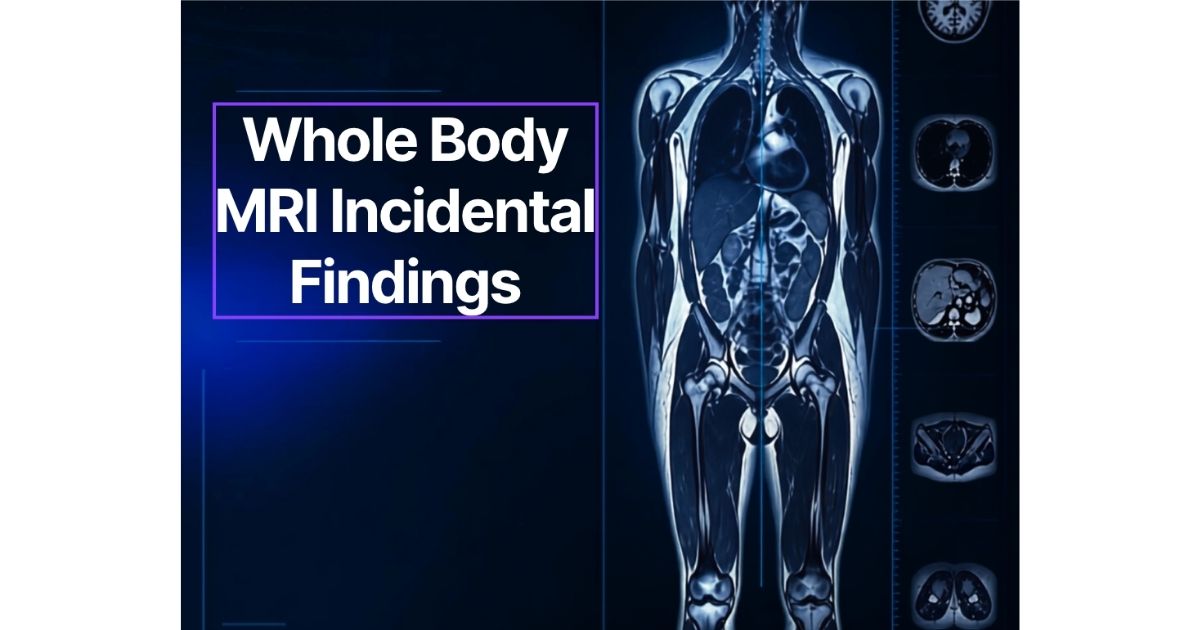
You’ve probably seen the arguing on X over the last few weeks. Andrew Huberman posted about whole-body MRI, said his neurosurgeon friends do “life-saving surgeries every month” based on scan findings.
Then, half of radiology and neurosurgery Twitter showed up to call it out. It’s a lot of noise.
But underneath all of it is a much simpler question almost nobody’s actually answering:
what does it actually mean when a whole-body MRI finds something unexpected in the first place, and what happens after?
That’s the gap I want to close here.
I’m a certified MRI Technologist with over a decade of hands-on clinical experience, and I used to work for Prenuvo at their start-up location.
I’ve watched incidental findings get flagged and reported from the inside, long before this became something people were fighting about online.
So this isn’t a piece about whether Huberman is right or wrong.
What this actually is: a clear, honest breakdown of what “incidental finding” really means, how it’s different from a “false positive”.
They’re not the same thing, and most coverage of this topic treats them like they are. Then I’ll cover what actually happens once something shows up on your scan. Let’s start with the term everyone’s using and almost nobody’s defining.
Table of Contents
What Counts as an “Incidental Finding” on a Whole-Body MRI?
So what is an incidental finding? In the simplest terms, it’s anything that shows up on your images that nobody was specifically looking for.
For instance, imagine the radiologist is looking at your brain because you’ve been having headaches. On one of the images the radiologist sees farther down your neck and mentions you have some swollen lymph nodes.
The lymph nodes weren’t likely to be causing the headaches, they’re just there. That is an incidental finding.
Now stretch that same logic across a whole-body MRI.
There’s no single complaint driving the scan at all as most whole body scans are elective and some are preventative in nature. Which means, technically, almost everything a whole-body scan turns up is incidental by definition.
There’s no “expected” finding the way there would be with a dedicated MRI, because nothing specific brought you in to begin with.
If there was a specific complaint, like routine headaches, the your doctor would likely order specific (diagnostic) imaging and testing for that complaint alone. They would not order a whole body “sweep”.
That’s not a flaw in the technology. It’s just the nature of scanning without a target.
I think this is actually the root of a lot of the confusion around whole body MRI incidental findings right now.
People hear “incidental finding” and their brain jumps straight to “problem.” They may even jump to “false positive”.
But the term itself just means unexpected — it says nothing about whether what’s found is dangerous, benign, or somewhere in between.
That distinction is what I want to walk through next.
Incidental Finding vs. False Positive vs. Radiologist Error — What’s the Difference?
So I’ve covered incidental finding above. There are two more circumstances that often get confused and lumped in together. Below, I will compare and contrast all three.
Incidental Finding
Incidental finding — the broad umbrella. Anything that shows up on your scan that wasn’t the reason you were being scanned in the first place.
This says nothing about severity. A finding can be completely harmless and still technically be “incidental.”
False Positive
This is where something gets seen accurately, reported correctly, and then worked up — a biopsy, more imaging, a specialist consult — only for that workup to come back clean.
Nobody made a mistake here.
The system did exactly what it was supposed to do; the finding just wasn’t the disease anyone was worried about.
This is actually the category most people mean when they’re venting about whole-body MRI false positives, even if they’re not using the term precisely.
People like to point fingers and whole body MRI turning up a lot of false positives. I’ll cover this more in-depth below.
However, I get a lot of follow-ups from ultrasound that require MRI for further investigation. I can say from experience that a lot of these wind up to be false positives and there isn’t much to be seen on the MRI.
So, I have first-hand experience that regular diagnostic testing can also result in false-positives.
True Postitive
Something shows up on your MRI (or whatever test you may be getting), and follow-up testing confirms it is the disease being tested for.
Radiologist Error
Radiologist error (or misread) — a genuinely different animal, and honestly the rarest of the three.
This is when something gets missed or misread on the images themselves.
It happens, radiologists are human.
A widely cited 2017 review in Insights into Imaging puts the day-to-day discrepancy rate across radiology somewhere around 3 to 5 percent.
Keep those straight, and a lot of the online arguing about whole-body MRI starts to make a lot more sense.
What I Actually See As the Technologist (and What I Don’t)
Working as an MRI technologist, I get asked routinely if I read the images, if I can see if something is wrong, if I can tell the patient what I see. I’ll break it down below.
Do I Read The Images
No. A radiologist does that. You do not want me reading your images. There have been plenty of times I “thought” I saw something and was darn sure.
Yet, the report came back and I was totally wrong.
You want a doctor who has gone to school for years and years (and years and years) to read your results. That’s a radiologist.
Can I See If Something Is Wrong?
Yes. Technologists have had some rudimentary training in ID’ing pathology. We can differentiate between normal tissue and abnormal (pathological) tissue.
Our wheelhouse is being able to identify contrast. In other words, I can tell if something looks like it is made out of fat, water, pus, muscle, air, etc.
We are also good at spotting abnormalities that don’t quite fit in with surrounding tissue the way they should.
Where our professional scope ends is that we cannot reliably determine what the medical pathology is and make a diagnosis.
This is a radiologists job.
More experienced techs can sometimes make an educated guess on what they think they are seeing, but we play no hand in the formal decision and reporting of the diagnosis.
Our main job is to acquire clear and diagnostic images for the radiologist to determine the diagnosis.
Tech Insider Note:

Something we do learn in school is how to spot a brain bleed and estimate how old it may be.

This allows us to act fast and contact a radiologist to quickly determine the next course of action.

I once had a patient who had an incidental brain bleed. I was instructed by the radiologist to call an ambulance so the patient could receive care immediately.
Can I Tell The Patient What I See?
No. This is one of the cardinal rules of being a technologist. I have had lots of experiences seeing pathology on scans that explain the patient’s complaints, yet I can’t say.
This can be one of the more difficult aspects of the job.
Tech Insider Note:

One thing I can tell patients is if I spotted metal on their scan. We are trained to identify the presence of metal. We cannot exactly say what it is but can make a guess.

We don't typically mention this unless it directly affects our ability to scan.

I once had a patient who had multiple strange foreign metallic objects inside the stomach.

We are trained to make the call whether scanning can continue safely, although we do try to chekc with a radiologist if one is available.

I then had to explain to the patient why I stopped the exam, which was the presence of unidentified metal objects (UMOs!👽).
How Common Are Incidental Findings, Really?
For this section, I am going to focus on two parts. First, my own personal experience scanning hundreds of patients. Secondly (and most reliably), the peer-reviewed scientific data.
1. My Own Professional Experience
I have scanned SO MANY whole body MRIs. I cannot exactly quantify it. But I can recall a distinct pattern that I have noticed.
That is, it is so rare to find nothing ( no incidental findings) in a whole body MRI that I cannot recall even one time. This doesn’t mean they don’t exist, it just means it’s rare.
Like I explained in section 4, as a tech, I can typically spot when something stands out when compared to normal healthy tissue.
In my own whole body scan there were a good 4+ incidental findings. I was young and healthy and did not have any particular health complaints.
In short, if I were to see nothing but regular textbook anatomy in a whole body scan, it would stand out to me as an outlier.
The Peer-Reviewed Science
Let’s put some real numbers behind this, because, conveniently, there is some actual data behind how often incidental findings occur. Below are two studies.
Richter et al., 2020, European Journal of Epidemiology
This study followed 3,371 people who got a whole-body MRI as part of a general population health study.
An incidental finding was disclosed to 30.3% of them.
Of those findings, 83.3% were suspected to be tumor-related enough to warrant a closer look.
And when researchers tracked what actually happened after that closer look, most of the resulting biopsies came back clean.
Zugni et al., 2020, Cancer Imaging
This is a systematic review, pooling data from asymptomatic screening populations.
It found that 95% of people screened had at least one abnormal finding somewhere in the images.
That number sounds alarming until you look at the next one: 91% of those abnormal findings were benign.
Only 1.8% of everyone screened had a finding that was even suspicious for cancer, and just 1.1% ended up histologically confirmed as actual cancer.
Overall, here’s the honest read of those numbers: yes, a whole-body MRI turns up something unexpected in a meaningful share of scans — anywhere from roughly a third to nearly all of them, depending on how loosely the study defines “finding.”
But the odds that any single finding turns out to be the disease you were quietly afraid of are low.
That’s not me softening the story for you. That’s what two separate peer-reviewed studies found when they actually tracked people through the process instead of just counting the initial scare.
Where the Current Huberman Debate Fits In
Speaking of the internet losing its mind — this is probably why you’re here in the first place, so let’s actually get into it.
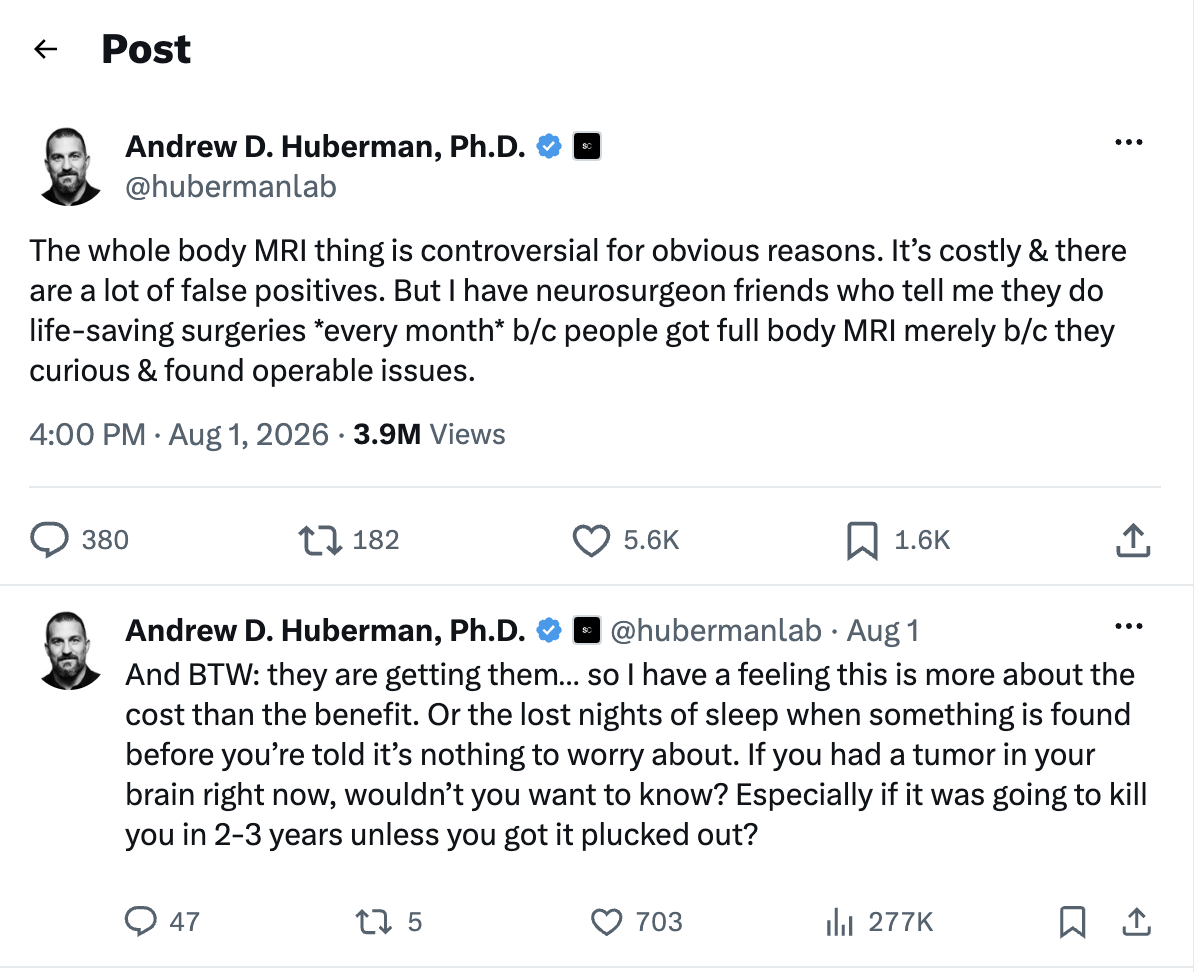
On August 1, 2026, Andrew Huberman posted on X that whole-body MRI is “controversial for obvious reasons” — “costly” and full of “a lot of false positives”.
Then he added that he has neurosurgeon friends who tell him they do “life-saving surgeries every month” because someone got a whole-body MRI out of curiosity and something operable turned up.
That last part is where things fell apart. Here’s who pushed back, and what they actually said:
Dr. Sanjay Dhall, UCLA neurosurgeon — called it “hogwash,” flat out.
Dr. Anthony DiGiorgio, UCSF associate professor of neurological surgery — “I have never once operated on any incidental ‘life saving’ lesion found on a whole body MRI.” He told USA Today that kind of intervention is “incredibly rare” in his own practice.
Dr. Francis Deng, Johns Hopkins neuroradiologist — called the claim “fantasy,” and raised a different concern entirely: that promoting scans like this to people with no medical indication pulls scarce radiologist and technologist time away from patients who actually need it.
Dr. Kurt Harris, neuroradiologist — even blunter: “A lie. Actually, there are no neurosurgeons who ever told him such a thing.”
Dr. Brandon Luu, internal medicine — the one voice in the mix who didn’t just dunk on him. He pointed out that cancer deaths happen in unscreened patients too, so “the scan found nothing that mattered” isn’t automatically true just because nobody ended up in surgery.
There’s also a financial thread worth naming plainly, Huberman is a paid scientific advisor to Function Health, which acquired Ezra in 2025. That’s disclosed on his own website.
It’s not hidded, but it’s easy to miss if you’re just scrolling past an X post, and Dr. Shariq Shamim, an interventional cardiologist, was one of the people who called this out directly.
So is his statement accurate?
Here’s what I’ll say: the data I walked you through above doesn’t support “every month” as some kind of norm.
It supports something closer to “this happens, and most of what gets flagged along the way doesn’t turn out to be dangerous.”
Somewhere between “life-saving miracle” and “hogwash” is where the actual evidence sits — and that’s a far less exciting headline than either side wants to give you.
A Real Example: What Happened With My Own Scan
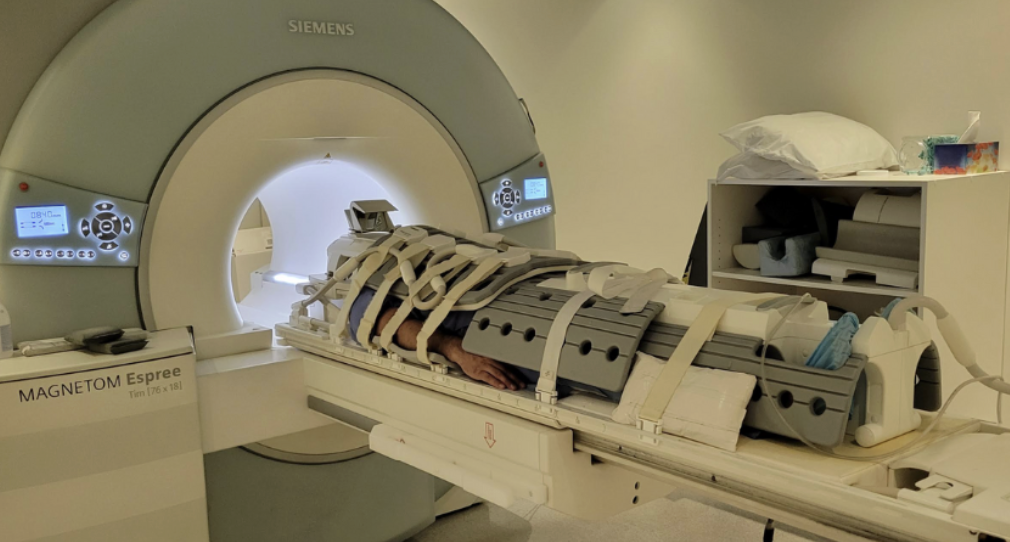
I don’t have to reach far for a real-life example, as I myself had incidental findings on my Whole Body MRI scan.
Two things came back that I wasn’t expecting: a small cyst on my thyroid, and moderate lumbar spondyloarthropathy, which is essentially wear and tear in my lower spine.
Neither one sent me into a hysterics. Neither one required surgery, a specialist referral cascade, or a single sleepless night.
What it did do was give my own doctor something concrete to work with.
Here’s the part that actually mattered: because that thyroid finding was already documented and characterized on my scan, my doctor was able to skip ordering a separate follow-up ultrasound she would have otherwise sent me for.
One less appointment, one less scan, one less thing sitting on my plate for weeks waiting on a booking.
That’s not a “life-saving surgery” story. It’s not going to trend on X. But it’s a real, honest example of an incidental finding doing something quietly useful instead of triggering a cascade of testing nobody needed.
Also, my doctor was fine with me getting a follow-up full body MRI scan and taking a look at the same cyst and my lumbar spine a year later to check up on them and track any progression.
Overall, this is what I mean when I say the data holds up better than the headlines. Most incidental findings aren’t dramatic. They’re not nothing, either.
Mine sat in that unglamorous middle ground. I was worth knowing about, and worth documenting.
In my case, the whole body MRI incidental findings did not result in my doctor having to order more testing or treatment.
What To Ask Before You Book (or Before Your Next Scan
So what questions should you ask before you book a whole body MRI?
Not “should I do this.” That’s between you and your doctor. This is about knowing what to expect once you’re already in the process.
1. Ask How Incidental Findings Get Communicated To You
Some companies send a full written report. Others walk you through results on a call. Know which one you’re signing up for.
2. Ask Who Reads Your Images
A radiologist should be reading and reporting every scan, not just a technologist glancing at it. That’s a fair, basic question for any provider.
3. Ask What The Referral Pathway Looks Like
Ask what the referral pathway looks like if something gets flagged.
Does the company connect you with a specialist? Or do they hand you the report and send you back to your own doctor? Both are common. You just want to know which one you’re signing up for.
Booking the scan is one decision. What happens after a finding leaves the scanner is a separate one, and it deserves its own conversation. I’m covering that next, so stay tuned.
If you’re weighing your options right now, compare Prenuvo, Ezra, and Elysian side by side before you commit.
Conclusion
So where does this leave us? An incidental finding is just something unexpected. Most of the time, it isn’t dangerous. Sometimes it’s genuinely useful, the way mine was. Occasionally it leads somewhere serious, and that’s exactly why it gets flagged and worked up in the first place.
In my opinion, that’s a far more honest story than either side of the Huberman debate is telling you. It’s not a miracle machine, and it’s not hogwash either. It’s a tool, and like any tool, what matters is understanding how it actually works before you decide what to do with it.
If you want to go deeper on what actually happens after a finding leaves the scanner, that’s exactly what I’m covering next.
Happy scanning.
FAQ
What is an incidental finding on a whole body MRI?
It’s anything that shows up on your images that wasn’t the reason you were scanned. On a whole-body MRI, there’s no single complaint driving the scan, so almost everything found is technically incidental. That doesn’t mean something is wrong. It just means it wasn’t expected.
What’s the difference between an incidental finding and a false positive?
An incidental finding is the broad category. Something unexpected shows up. A false positive is one possible outcome of chasing that finding down. It gets seen accurately and reported correctly, but the follow-up work, like a biopsy or more imaging, shows it isn’t the disease anyone was worried about. Nobody made a mistake. The workup just came back clean.
How often do whole body MRI scans find something incidental?
It depends on the study, but the range is wide. One 2020 study found an incidental finding in about 30% of participants. Another found that 95% of people screened had some abnormal finding, though only 1.8% turned out to be suspicious for cancer, and just 1.1% were confirmed. Something showing up is common. Something dangerous showing up is not.
Does the MRI tech decide whether a finding is important?
No. A radiologist decides this. To a certain extent, since the tech is the first person to see the images, they can decide whether to contact the radiologist. It is then up to the radiologist whether they want to expedite further care or investigation.
Is Andrew Huberman right that whole body MRI leads to life-saving surgery every month?
Not based on the data. Several neurosurgeons who publicly responded to his post said they’ve rarely or never operated on an incidental finding from a whole-body MRI. The research backs that up too. Most incidental findings don’t turn out to be dangerous. That doesn’t mean these scans are pointless. It means “every month” isn’t the norm.
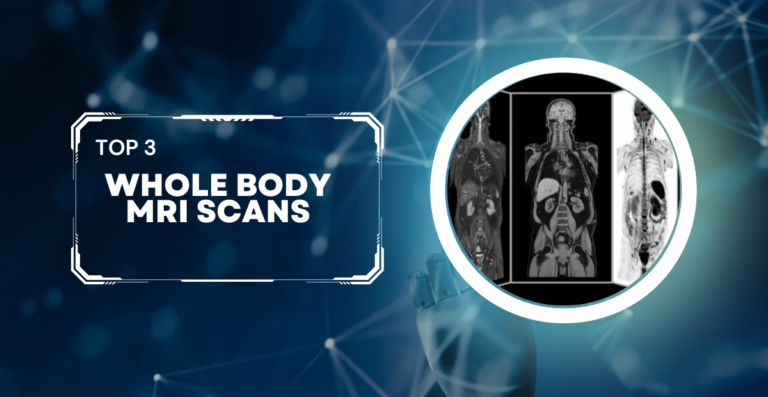
Who Are The Top Whole Body MRI Providers?
In this article, I go over this year’s top picks